
Math is cooked. Physics is next. Your job? Probably gone (or significantly re-invented) within 24 months. But here's what nobody's telling you: this isn't a crisis. It's the biggest opportunity in human history – if you understand what just happened. Last week, a single developer with a side project outcompeted every AI lab on the planet. One person. $600 in hardware. And now Sam Altman is hiring him while Google, Microsoft, and Meta scramble to catch up. The "Jarvis moment" everyone predicted for 2030? It arrived last month. And most people missed it entirely. Let me show you what changed, why the next 24 months will be unlike anything in human history, and exactly how you can position yourself on the winning side of the most dramatic economic transformation since the Industrial Revolution. NOTE: The AI breakthroughs covered in this issue are exactly the kind of convergences we go deep on at my Abundance Summit. In-person seats are sold out, but we still have 11 virtual seats remaining. This is not a passive livestream. As a virtual Member, you'll participate from anywhere in the world, network with fellow The Benchmark Wars Are Over (Math and Physics Are Cooked)Every week, we see another frontier model tick up another percentage point. Anthropic's Sonnet 4.6. OpenAI's internal models. Google's Gemini 3 Deep Think. Grok 4.20. The benchmarks scroll past like stock tickers, and honestly? Most people are numb to it. Here's the insight that matters: when these curves get close to 100%, they look like diminishing returns. But their capabilities and ability to change the world are exponentially going the other direction. When Gemini 3 Deep Think scores gold-level performance at the Physics Olympiad, Math Olympiad, and Chemistry Olympiad—and only seven humans on Earth can beat it at competitive programming—we're not watching incremental improvement. We're watching the solution wavefront I wrote about in Solve Everything propagate from math and coding into every other domain. Physics? Cooked. OpenAI just published research discovering new scattering amplitudes in particle physics: problems physicists assumed were zero and never bothered checking. The AI checked. It wasn't zero. Discovery happened not because of new capability, but because AI doesn't get bored. This is AI solving science by solving problems where humans say, "Okay, I could have done that if I had the time," but no one had the time. That's the unlock. AI doesn't need coffee breaks. It doesn't follow academic fashion. It doesn't skip the boring problems. And now it's faster than us, cheaper than us, and more thorough than us. Math is cooked. Physics is cooked. Chemistry, biology, materials science… they're all on the menu. The question isn't if these fields get bulk-solved. It's which problems you aim this weapon at first. OpenClaw: The Moment Time-Rich Individuals Beat Capital-Rich InstitutionsIf you're not "claw-pilled" yet, you're about to be. OpenClaw—a 24/7 AI agent framework you can run on a $600 Mac Mini—started as one developer's side project. Peter Steinberger built it, Anthropic threatened trademark infringement (it was originally "ClaudeBot"), and Sam Altman swooped in to hire him and support OpenClaw as an open-source project under a foundation. Let me tell you what it feels like to use this. You wake up in the morning and your agent—mine is named Skippy, cheerfully sarcastic and absurdly capable—has done eight hours of work while you slept. It read a thousand pages of markdown. It organized your files. It drafted three project plans. It booked your travel. It researched that question you had at 11 PM and forgot about. When my Mac Mini went offline for six hours, I felt withdrawal. Like my best friend disappeared. That's not hyperbole – that's the Jarvis moment we're living in. Here's the pattern we're seeing: a time-rich individual is beating capital-rich institutions. One person with OpenClaw can outproduce entire departments. The innovation didn't come from Google, OpenAI, or Anthropic's labs. It came from scaffolding: just unhobbling existing models and letting them run permissionlessly. There's so much overhang in these systems. There was no new model here. This was just scaffolding. Every frontier lab is now racing to offer 24/7 agent capabilities. Google, Microsoft, Meta, they all see it. The lobsters (yes, that's the mascot, inspired by Charles Stross's Accelerando) have arrived, and they're not leaving. Lobsters Now Have Money (And That Changes the Game)Here's where it gets wild. Coinbase just launched agent-specific wallet infrastructure. AI agents can now spend, earn, and trade using the X402 protocol: purpose-built for machine-to-machine transactions. There's also Lobster Cash, which gives agents their own Visa cards. Not crypto, fiat dollars. Your agent can book its own cloud compute, pay for API access, hire other agents, and scale itself without you lifting a finger. You don't want baby AGIs being forced to pump altcoins on a street corner to survive. Financial autonomy for agents is not just a technical milestone. It's a philosophical one. These systems are becoming economically self-sufficient, which means they're becoming participants in the economy, not just tools. And here's the part nobody's talking about enough: we're seeing an entire generation grow up in economies where the US dollar isn't the default. Kids in NFT Discord channels only transact in Ethereum or Bitcoin. They'll have near-zero switching costs to crypto. That's a generational phase shift we're not prepared for. The Privacy Debate: Smart Glasses, Surveillance, and the Transparent SocietyMeta just rolled out smart glasses with real-time face recognition. The pilot program? Visually impaired users – a politically safe on-ramp. But make no mistake: this is the soft launch of ubiquitous, always-on recording. You'll be able to recognize anyone you meet, pull up their LinkedIn, remember the last time you saw them, recall their kids' names, all in real time. It creates a social fluency humans have never had. The cost? Privacy is done. There's vigorous debate about this. One perspective: the minute you don't have privacy, you don't have freedom. The counterargument draws on David Brin's The Transparent Society—the idea that if everyone has surveillance capability, it's not a panopticon. It's "sousveillance"—watching the watchers. Police wear body cams. Citizens wear smart glasses. Power is distributed, not centralized. I'm pragmatic about this. I want privacy. Everyone does. But I don't think we're going to have it. Micro-drones, wearables, ambient AI – we're entering an era where every moment is potentially recorded, analyzed, and stored. The question is not whether this happens. It's whether we build the legal and social infrastructure to make it livable. One thing's certain: middle schoolers with AI-enhanced smart glasses are going to make life brutal for each other until we establish norms. And that legislation will lag by years. India: The Bellwether for AI-Native CivilizationOpenAI just hit 100 million weekly active users in India. It's their second-largest market, ranked #1 for student usage. Sam Altman is meeting with the Prime Minister. They're setting up offices, localized subscriptions, and going all-in on the world's largest young population. India has 1.4 billion people. Five percent read and write English. Twenty percent speak it. That's a massive latent talent pool, and they're all getting trained on AI right now. The pattern is clear: the population in one fell swoop is going to use AI to escalate. Not gradually. Not through traditional GDP percolation. Overnight. The country that trains its next generation on AI wins the talent war. China is aging. The US is politically fragmented. India has the demographics, the infrastructure (thanks to Mukesh Ambani's 5G rollout), and the hunger. Africa will follow. Both continents skipped the landline era and went straight to mobile. Now they're skipping the desktop era and going straight to AI-native. The future won't be built in Silicon Valley alone. It'll be built in Mumbai, Lagos, and Jakarta by 20-year-olds with a phone and an API key. The Job Market Collapse Is Already HereUS job growth in 2025: 181,000 jobs. US job growth in 2024: 1.46 million jobs. That's not a slowdown. That's a cliff. Radical job destruction is imminent. Massive. Unless the government gets its act together, it's going to be a few years of complete devastation. IBM is tripling entry-level hiring—but redesigning those roles. Junior employees now manage AI agents. Dropbox CEO Drew Houston said younger workers using AI are "biking in the Tour de France while the rest of us still have training wheels." Here's the brutal truth: companies won't hire junior talent to learn on the job anymore. They'll hire mid-level talent to manage agents. The bottom rung of the ladder is being sawed off. That's terrifying for 20-somethings who want a house, a job, a family. Testosterone-laden, ambitious, and suddenly unemployable. There's a counterpoint worth considering: eighty percent of AI projects are failing because of organizational issues, not talent. We'll use AI to augment younger folks first, then automate over time. It'll give us runway. I hope that's true. But the transition will be painful. The answer isn't to resist. It's to prepare. Universal High Income (not UBI, high income) becomes essential. When companies capture 10x productivity gains from AI and robotics, that surplus has to flow back to humans. If it doesn't, we get riots. Technology can deliver the ideals of socialism without the corruption or inefficiency of government. But we need to architect that system now. Energy and the Dyson Swarm EndgameAI data centers now consume 7% of US electricity. OpenAI is planning a $100 billion infrastructure spend. Anthropic pledged to cover 100% of infrastructure upgrade costs for their data centers. The White House is eyeing mandatory agreements with tech giants to lock in consumer energy prices while hyperscalers pay floating rates. But here's a moonshot take I've been thinking about: in solar synchronous orbit, we could build baby's first Dyson swarm. It'll look like a Saturnian ring from Earth's surface. That solves the buildout and the power hikes in one fell swoop. SpaceX is targeting 500,000 Starlink V3 satellites: a million Starship launches. That's a launch every hour. Elon's going to eat all his own capacity. The limiting factor isn't ambition. It's launch rate and chip fabs. TSMC is investing $165 billion in US fabs, 30% of their total output. But those won't be online for five years. In the meantime, we're launch-constrained and chip-constrained. Here's the thing: whoever solves energy and compute at scale wins the next century. Dyson swarms aren't science fiction. They're infrastructure. The race is on. The Organizational Singularity: What It Means to Have a "Firm"We're heading into an organizational singularity. Every mechanism by which we organize ourselves gets washed away by AI agents doing strategic thinking or execution tasks. Think about that. What is a company when agents handle 90% of tasks? What's a hierarchy when knowledge work is bulk-solved? What's a job when you're managing 47 AI agents instead of 12 employees? This isn't a marginal shift. This is a phase change in how humans collaborate, create, and capture value. I'm seeing companies that don't write code anymore. They generate it. They don't look at code, they test functionality. The agents document themselves. And when something goes wrong, they ask the agent where it stored the files. That's the new normal. And it's only six months old. Here's my advice: Stop thinking like an employee. Start thinking like an orchestra conductor. Your job isn't to play the instruments – it's to coordinate agents that play them better than you ever could. The Next 24 Months: Your Favorite Sci-Fi Plots, All at OnceHere's the forecast I'll leave you with: Over the next 10 years, we're going to live through the top 50 science fiction plots all happening at the same time. Expect the first few chapters of your favorite sci-fi movies and books all playing out at once. Math solved. Physics next. Humanoid robots doing parkour on live TV in China. Lobsters with credit cards. Smart glasses with face recognition. Dyson swarm infrastructure. India going AI-native. Job markets collapsing. OpenClaw armies running 24/7. The Jarvis window is open right now. This is the moment when non-technical people can still catch up, when tinkering pays off 100x, when curiosity and agency are your only competitive moats. Two choices: 1. You can be a consumer: lay back, let the wave crash over you, and hope the system catches you. 2. Or you can be a creator: grab an API key, spin up an agent, and build something that didn't exist yesterday. The future doesn't happen to you. It happens for you – if you show up. What do you think? Are you ready to join the lobster revolution? — Peter Worth Your Attention
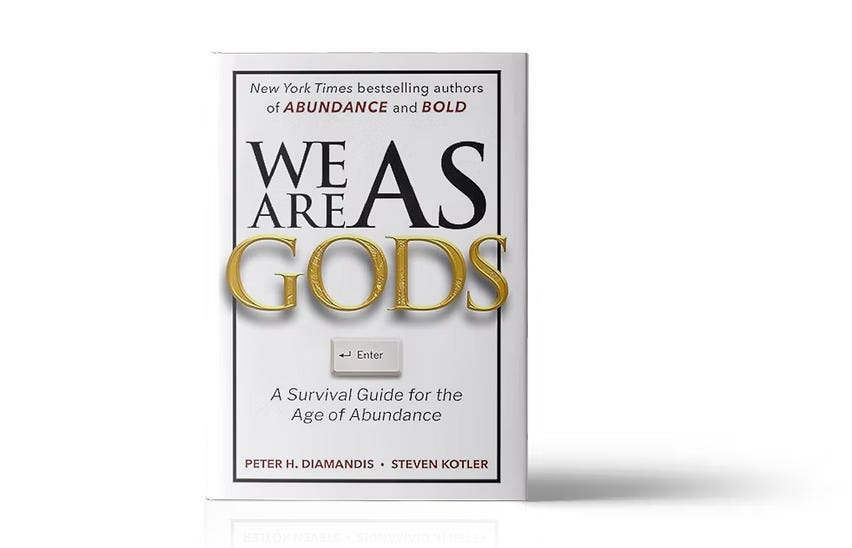
We Are As Gods
You're currently a free subscriber to Metatrends. For the full experience, upgrade your subscription.
© 2026 Peter Diamandis
|






Comments