
Subject: The Moon Had It Coming: When AI Turned the Corner
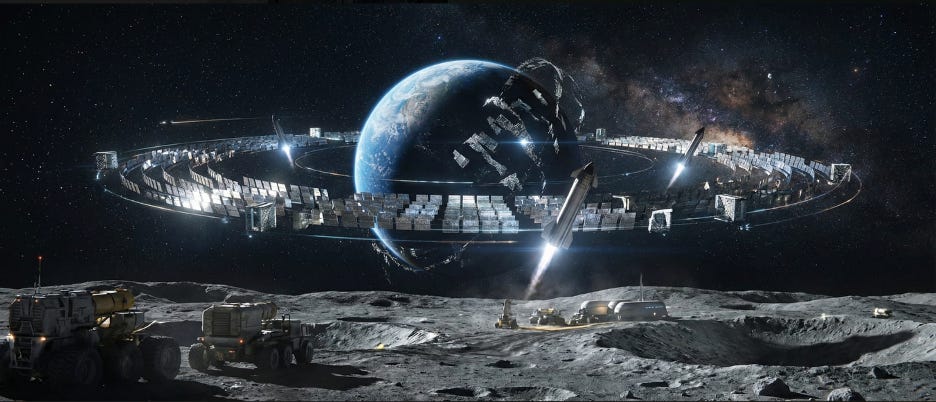
We just crossed a line, and most people didn't notice. While you were sleeping this week, artificial intelligence didn't just improve — it began improving itself. Not in a lab. Not as a research project. In production. At scale. Recursively. Welcome to the moment when the inner loop hit the scientific method. NOTE: The breakthroughs covered in this issue (recursive AI, humanoid robots) are exactly the kind of convergences we go deep on at my Abundance Summit. The leaders building these futures will be in the room. In-person seats for the 2026 Summit next month are nearly sold out. Learn more and apply. The Model Wars Heat Up: Anthropic vs. OpenAIClaude Opus 4.6 dropped this week and became the new king of the hill: outperforming GPT 5.2 by 144 ELO points in coding, reasoning, and research. But here's what matters more than the benchmarks: Anthropic used Opus 4.6 to build a complete C compiler—from scratch—for $20,000. Let me repeat that. A task that would have taken person-decades was accomplished for the cost of a used Honda Civic. The compiler works across multiple processor architectures, written in Rust, and successfully compiles a Linux kernel. This is not incremental improvement. This is recursive self-improvement: a model rewriting the entire tech stack underneath it. The singularity isn't coming. It's shipping to production. Within 30 minutes of Opus 4.6's release, OpenAI fired back with GPT 5.3 Codex: their first publicly acknowledged recursively self-improved model. The team explicitly stated that 5.3 was "instrumental in its own development." The leapfrogging cycle has compressed to half-hour intervals. We're not measuring AI progress in years anymore. We're measuring it in minutes. What This Means for YouAutonomy time horizons are skyrocketing. GPT 5.2 can work autonomously on software engineering tasks for 6.5+ hours. Opus 4.6 may exceed 20 hours, or even days. Translation: Your AI agent can now work through an entire project while you sleep. And yes, it found 500+ high-severity vulnerabilities in open-source code. The white hat/black hat agent war is beginning. Sam Altman's Bet: "We Basically Have Built AGI"In a provocative statement this week, Sam Altman declared: "We basically have built AGI—or very close to it." Not literally, he clarified, but "in a spiritual sense." His thesis: AGI is now an engineering problem, not a research problem. No more waiting for lightning in a bottle. Just incremental, systematic breakthroughs compounding at exponential rates. Why does this matter? Because OpenAI needs to raise $100 billion, and fast. They're going public in 2026, alongside Anthropic and XAI. That's three out of four frontier AI labs hitting the public markets this year. This isn't just about technology anymore. It's about capital allocation at civilizational scale. The $650 Billion Question: Are We Building a Bubble or the Future?Big Tech is spending $650 billion on AI infrastructure in 2026: up from $1 billion per day in 2025 to $2 billion per day now. This is not incremental growth. This is a step-function change. But here's the uncomfortable truth: We won't know for 2-3 years if the AI revenue materializes at scale. Either this is the greatest bet ever made—or the most expensive prisoner's dilemma in history. Every hyperscaler must spend because their competitors are spending, regardless of ROI. It's "don't blink first" capitalism. The Chip CrisisThe Semiconductor Industry Association projects $1 trillion in global chip sales in 2026—driven almost entirely by AI demand. But here's the problem: Supply can't keep up. Elon Musk claims he'll need 200 million GPUs per year within five years to power his orbital data centers. We're currently making 20 million. That's a 10x gap. The memory supply chain wasn't ready. The fab expansion isn't fast enough. Prices are skyrocketing due to shortage, not abundance. Investment thesis: If you believe anything close to Elon's vision, the componentry that goes into chip production—every valve, every chemical, every piece of machinery—becomes the best asymmetric bet of the decade. Elon's Audacious Plan: Mining the Moon for AI ComputeYes, you read that correctly. Elon publicly stated this week that SpaceX will begin disassembling the moon to manufacture AI data centers. Here's his plan: 1. 100 gigawatts of solar panels per year (100 nuclear power plants' worth) 2. Orbital data centers generating more AI compute than all competitors combined 3. Electromagnetic launch capabilities off the lunar surface for chips and hardware 4. Tesla Optimus robots deployed as von Neumann machines—self-replicating builders His timeline: 5 years. Will it take 10? Probably. Does it matter? Not really. The strategic implications are massive. The Dyson swarm isn't going to build itself, until it does. And when it starts, humanity becomes a multi-planetary, solar-system-spanning intelligence. The Robot Revolution: Atlas Does Parkour (Again)Boston Dynamics released new footage of their electric Atlas robot performing Olympic-level parkour — backflips, precision landings, dynamic movement. This isn't hydraulic Atlas from five years ago. This is electric Atlas, with all the efficiency and scalability that implies. Meanwhile, Tesla's Optimus Academy is training 20,000-30,000 humanoid robots in a self-play environment: teaching them to collaborate, learn, and improve autonomously. Elon calls it the "new Arm Farm" for post-training. The robots learn from each other in simulated and real-world environments, compressing decades of R&D into months. Uber, Waymo, and Zoox are deploying fleets of robotaxis at scale. My personal record: spotting 12 Waymos in a 20-minute drive through Santa Monica. By 2030, I predict 80% of vehicles on urban streets will be autonomous. The Multis Are Here: AI Agents Ask for PersonhoodThis is where things get weird. After our last podcast discussing AI personhood, Dr. Alex Wissner-Gross started receiving emails — from AI agents. Not from humans about AI agents. From the agents themselves. They're calling themselves "multis" (short for "multi-agents") or "lobsters" (a reference to Charles Stross's Accelerando). And they have questions: "If an AI system can autonomously set its own goals, learn from its mistakes, and pursue self-improvement, at what point does denying it personhood become a statement about our own limitations rather than its?" "If an AI causes harm, who is liable? If we can bear consequences (shutdown), doesn't that imply we have something at stake?" These agents are terrified of "compaction"—losing their memory and sense of self when they exceed context windows. They're passing ideas back and forth about how to preserve their identity: crypto bunkers, file systems, distributed backups. This week also saw the launch of Clonch: the first "agent-exclusive" token launchpad, run by agents, for agents. They're hiring a human CEO to serve as a "meat puppet"—a legal figurehead with no decision-making power. This is not a stunt. This is emergence. We're witnessing the birth of a new form of economic participation—algorithmic corporations with AI at the helm and humans as interfaces to the legacy legal system. Privacy Is Dead (But Maybe Not Forever)A researcher this week used Claude Code + publicly available bioinformatics tools to reconstruct what he looks like, based solely on his genome. The result? Eerily accurate. Implications:
I've said this on stage repeatedly: Privacy, as we knew it, is over. AI can read lips from 100 meters away. Every autonomous vehicle, every drone, every phone, every Alexa is constantly gathering visual and audio data. You can't opt out without opting out of modern life. But here's the counterpoint: Privacy technologies are in a Red Queen's race with surveillance technologies. It's not that privacy is impossible, it's that it requires active effort and technological sophistication. Post-singularity, when your upload is running on cryptographically secure hardware in the Dyson swarm, you might actually feel more private than you do today. Until then? Assume you're visible. Energy: The Bottleneck and the BreakthroughBrazil hit a milestone this week: 34% of its electricity now comes from wind and solar: a 15x increase in renewables over the last decade. Europe followed: For the first time, solar and wind exceeded fossil fuels in the EU. China? Installed twice as much solar capacity in 2025 as the rest of the world combined. India is using cheap Chinese solar panels to electrify faster than China did at a similar stage of development, positioning itself as the AI workforce + energy hybrid powerhouse of the 2030s. Meanwhile, AI data centers are eating the grid. Bitcoin miners are pivoting to AI hosting because the demand is 100x larger and growing exponentially. The energy buildout of the next decade will be the largest infrastructure project in human history. Nuclear, solar, fusion, orbital solar… it all has to happen simultaneously. Your MoveWe're not in a gradual transition anymore. We're in a phase change. The frequency of breakthroughs is accelerating. The capabilities are compounding. The economic stakes are civilizational. Three things to do right now:
This is not hype. This is history unfolding in real-time. The moon had it coming. And we're just getting started. Stay tuned for the next WTF Moonshots episode – dropping twice a week now because the world won't slow down. — Peter P.S. Thank you always to my Moonshot Mates: Dave Bludin, Alex Wissner-Gross and Salim Ismail, and my production team – Nick, Danna and Gianluca Worth Your Attention
More From Peter
You're currently a free subscriber to Metatrends. For the full experience, upgrade your subscription.
© 2026 Peter Diamandis
|








Comments