
From: Peter H. Diamandis <metatrends@substack.com>
Date: Sat, May 23, 2026 at 11:07 AM
Subject: Tracking the Singularity: Week of May 21st
To: <SIPanticINC@gmail.com>

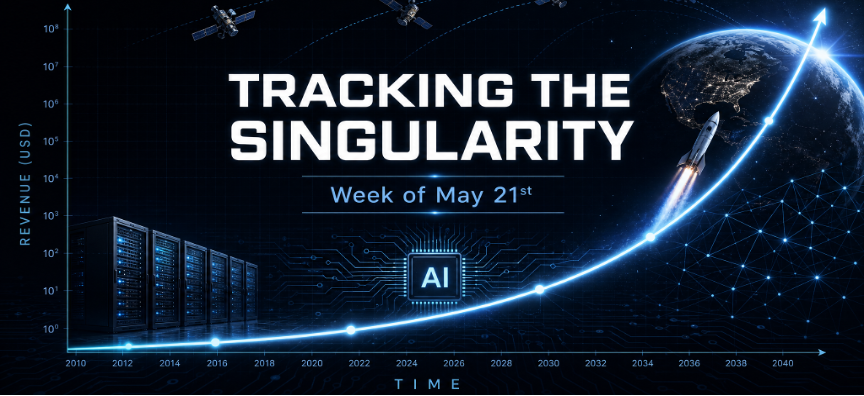
Tracking the Singularity: Week of May 21stSpaceX Files the Largest IPO in History, AI Cracks 80-Year-Old Math, and Your Financial Advisor Might Be a Chatbot
TLDR: This was one of those weeks where every story could have been the lead. SpaceX filed for what will be the largest IPO in human history. An OpenAI model disproved a conjecture that has stumped mathematicians for 80 years. ChatGPT became your financial advisor. Chinese AI labs are beating every American competitor in video generation. Colossal Biosciences hatched chicks from artificial eggs. And a generation of students booed Eric Schmidt for mentioning AI at their graduation. We covered all of it on this week’s Moonshots podcast with my mates Dave Blundin, Alex Wissner-Gross, and Salim Ismail. Let’s get into it. THE SPACEX MEGA-IPOSpaceX filed for a $75 billion raise at a valuation north of $1.75 trillion, 2.5 times larger than Saudi Aramco’s record. Elon maintains super voting rights with insiders controlling 86% of voting power. The prospectus claims a total addressable market of $28.5 trillion. That breaks down to $870 billion for Starlink broadband, $740 billion for Starlink mobile, $600 billion for digital advertising through X, $2.4 trillion for AI infrastructure, and a staggering $22.7 trillion from Macrohard, their partnership with Tesla to replicate all digital work with AI. “The TAM is just under the size of the entire US GDP. I’m sure they landed on it so they don’t want to claim to be bigger than the entire US.” (Dave Blundin)So, what’s the buried bombshell? Anthropic is now paying SpaceX $15 billion per year for data center access, covering both Colossus 1 and Colossus 2. Alex read the tea leaves: SpaceX is abandoning the foundation model space, handing it to Anthropic, and focusing on becoming the infrastructure layer, building out the Dyson swarm. SpaceX is also going through with its $60 billion option to acquire Cursor, the AI coding tool built on Chinese open-weight models. Own the layer below (infrastructure) and the layer above (applications). My key insight is that, once public, SpaceX will have currency for a shopping spree: “These guys can easily do a thousand acquisitions of a billion dollars or more. Remember, unicorn is called unicorn because it’s supposed to be extremely rare. That’s just a whole new world.” (Peter)I was on CNBC the morning of the IPO filing, and my message to the investor community is simple: “You can’t think about SpaceX from Starlink revenue alone. SpaceX is opening up the space frontier, and everything we hold as valuable (metals, minerals, energy, real estate) exists in near-infinite quantities in space.” (Peter)By the way, Polymarket gives a 20% probability of SpaceX and Tesla merging by year’s end. I personally think this will happen within a year, by mid-2027. STARSHIP V3: PACKET-SWITCHING THE SOLAR SYSTEMFlight 12 of Starship launched this week with the Raptor 3 engine delivering 18 million pounds of thrust and a 100-ton payload capacity. The big demonstration: orbital docking ports required for refueling, a critical milestone for the Artemis lunar missions (docking test in 2027, lunar surface landing in 2028). I argue that Starship had a massive lead over other companies. Dave and Alex believe other launch providers can catch up. Dave noted Starship was built entirely without AI design assistance. Elon called it the greatest thing ever built by humanity without AI. But all future launch vehicles will be AI-designed, which could accelerate competitors like Eric Schmidt’s Relativity Space, Bezos’ Blue Origin, Rocket Lab or other providers still in stealth. OPENAI’S TRIPLE PLAY: MATH, FORECASTING, AND FINANCEAI Disproves the Erdos ConjectureAn internal OpenAI model (not yet publicly released) disproved Paul Erdos’s 80-year-old unit distance conjecture, one of the most famous open problems in combinatoric geometry. Erdos conjectured that the maximum number of point pairs at a fixed distance scaled linearly. The AI found weakly super-linear scaling. It was verified by Fields Medalist Tim Gowers and other mathematicians. What stunned the professional mathematicians reviewing the reasoning chain wasn’t raw speed. It was creativity. “OpenAI’s model was pursuing exotic possibilities that humans would be too exhausted to try. The reasoning trace that led to the solution began with ‘optimistically, if I pursued this, something might happen.’ And that turned out to be it.” (Alex Wissner-Gross)Dave compared it to AlphaGo’s Move 37: “The final AI solution is beautiful, elegant, and not intuitive at all. It looks like a chip design problem. The answer doesn’t look intuitive to a human, but it’s better. This is a much bigger moment than just solving a math problem.” This is the starting gun. While people might not relate to math, they’ll care plenty when AI does this in physics, chemistry, biology, and materials science. Those breakthroughs will birth trillion-dollar outcomes over and over. GPT 5.5 Beats Prediction MarketsGPT 5.5 running Codex scored 25% accuracy on FutureSim, a benchmark from independent researchers that replays the internet day by day and asks models to forecast real events 90 days out without web access. It beat Polymarket crowd predictions for the Super Bowl. I commented that the ability to predict the future and simulate the future will give AI the property of wisdom, being able to know which is the best path of all the options. Salim sees immediate enterprise applications: “This is incredibly powerful for the boardroom. You go from quarterly updates to real-time accurate predictions.” Dave went even further, predicting a “financial singularity,” where the entire hedge fund industry collapses into a few mega-funds running AI across all markets simultaneously. Alex invoked Isaac Asimov’s psychohistory from the Foundation novels: “This is the worst psychohistory models will ever be.” ChatGPT Becomes Your Financial AdvisorOpenAI launched personal finance in ChatGPT, connecting to over 12,000 financial institutions through Plaid. Pro users can now ask personalized questions about spending, debt, taxes, and long-term planning. This is OpenAI eating another vertical after search and coding. Alex’s hot take is that the real play is advertising: “OpenAI is following the Google playbook. Financial queries are enormously lucrative for ad targeting.” On the same day, Dario Amodei announced Anthropic will never run ads. As Alex quipped: “Very easy to be an angel in heaven.” Dave agreed: “It’s OpenAI versus Google watching this ad evolution play out.” CHINA WINS THE VIDEO GENERATION RACE (FOR NOW)ByteDance’s Seedance 2.0 and Kuaishou’s Kling now rank first and second on independent video model leaderboards, beating every American competitor. The reason isn’t algorithmic superiority. It’s data. TikTok has generated billions of hours of video that no US company can match. Dave connected it to the broader startup picture: “Video generation uses the same transformer architecture. You compress video into a latent space, then decompress it. But chemistry, biology, and physics all have latent spaces too. If the Chinese sustain a lead in video’s latent space, that’s a leading indicator for every startup maintaining a lead in their own domain.” Salim added: “TikTok and Douyin are huge training loops disguised as entertainment platforms.” THE GENERATION BOOING AIEric Schmidt got booed at a University of Arizona commencement for mentioning AI. His words weren’t even controversial, just “AI is the next industrial revolution.” But when the job market feels like it’s disappearing for new graduates, facts sound like threats. Perhaps it’s not AI that deserves the criticism, but our university degree models that continue to teach for a future that is vaporizing, rather than helping our youth become AI-enabled entrepreneurs. At Stanford, a survey of 849 CS majors found 49% would rather cheat than fail, and AI tools are used in nearly every class. Stanford has introduced proctored in-person exams for the first time ever. Dave, who teaches AI ventures at MIT, had the counter: “If your business plan gets funded, you get an A. You don’t have to have tests at all. The schools are struggling to hold on to something that makes no sense anymore.” Salim went on a rant I’m still thinking about: “Who the students should really be booing is the universities that sold them a credentialing system that’s radically out of date. They’ve been sold a bum deal. They’re in huge debt with no prospects. This is the biggest entrepreneurial opportunity in the history of education.” My message to parents with kids in high school or college: encourage them to learn entrepreneurship. We just launched the Build with Gemini XPRIZE, with $3 million from Google, challenging teams to pick a problem impacting 100,000 people and build something that generates revenue in three months. Over 2,000 registered in the first 24 hours. Rather than booing AI, use it. Don’t get a job. Build a job. META IS WATCHING ITS EMPLOYEESMeta installed software tracking mouse movements, clicks, and screen activity on employee computers. The stated reason: training AI agents. Employees launched protests at multiple US offices. An engineer’s internal post was viewed 20,000 times. This happened the same week Meta cut 10% of its workforce. Alex had a contrarian take: “It strains credibility that there’s enough diversity of computer use within Meta for this to be worth the hostility. I’d lean into synthetic data. This almost seems like a way of encouraging a subset of employees to just quit.” Dave agreed: “The use of this data is nonsensical as a training tool. This is entirely about performance evaluation.” Salim brought the data point: “44% of Gen Z workers are deliberately sabotaging the AI they’re supposed to train.” COLOSSAL HATCHES CHICKS FROM ARTIFICIAL EGGSColossal Biosciences, the de-extinction company founded by Ben Lamm and George Church, PhD successfully hatched 26 live chicks from fully artificial eggs. This is one of three artificial womb programs they’re running, critical technology for bringing back the dodo bird, the woolly mammoth, and 15 other species in their pipeline. Personally, I’m a huge fan of Ben and what his company has built. He has three artificial womb programs in development: one for mammals, one for marsupials, and this one for avian species. Their mission is to enable ex utero gestation for their de-extinction efforts and to help bring back species on the brink of extinction. Salim summed it up: “Biology is becoming programmable. That’s just a huge, huge thing.” FYI, Ben Lamm will join us on stage at the Moonshots Gathering in September. THE ENERGY BOTTLENECKThree data center stories worth noting. A Gallup poll found 70% of Americans oppose data center construction in their community. Nevada Energy is redirecting 75% of Lake Tahoe’s electricity supply to data centers by 2027. And Texas surpassed California in utility-scale solar, almost doubling its capacity in five years. Here’s Alex’s framing: “Until we build the Dyson swarm, kilowatts want to flow to their highest productivity outcomes. Texas is the closest thing America has to a special economic zone.” Salim nailed the core truth: “Energy is becoming the balance sheet of AI.” THE ORGANIZATIONAL SINGULARITYSalim presented his thesis on the Organizational Singularity, and I’d encourage everyone to watch the full hour-long deep dive we recorded. The core argument: 80% of AI projects fail because companies try to cram AI into human-centric workflow loops. The fix isn’t incremental. It’s a complete rewrite. “It’s easier to build a product feature than to have a meeting about building the product feature. That’s how broken legacy organizations are.” (Salim Ismail)His solution is to build an AI-native digital twin at the edge, move workflows over one by one, and let the new architecture become the gravity center. Companies doing this are running 100x more productive than legacy competitors. He challenged every CEO listening: “Can two people with an LLM replicate a major line of your business in 60 to 90 days? If so, you have an existential threat right now.” Go to Organizational Singularity to learn more. HERE’S THE BOTTOM LINESpaceX is about to become a $1.75 trillion public company with currency to reshape every industry it touches. AI is cracking math problems that stumped humanity for 80 years, predicting the future better than crowds, and eating another $12 billion vertical in personal finance. China is winning video generation because they have TikTok’s data. A generation of graduates is furious because nobody told them the rules changed. Biology is becoming programmable. And the organizations that survive will look nothing like the ones we built in the 20th century. The technology isn’t slowing down… will we build the social contracts fast enough to keep up? Catch the full episode on YouTube, Apple, or Spotify. Join me and the Moonshot Mates at the Moonshots Gathering in Los Angeles on September 25th – learn more at www.moonshots.com. See you next week, Peter More From Peter
You're currently a free subscriber to Metatrends. For the full experience, upgrade your subscription.
© 2026 Peter Diamandis
|







Comments