
From: Peter H. Diamandis <metatrends@substack.com>
Date: Fri, Feb 6, 2026 at 2:47 PM
Subject: Space GPUs, Humanoid Armies & Why China Wins Unless We Build Optimus
To: <SIPanticINC@gmail.com>
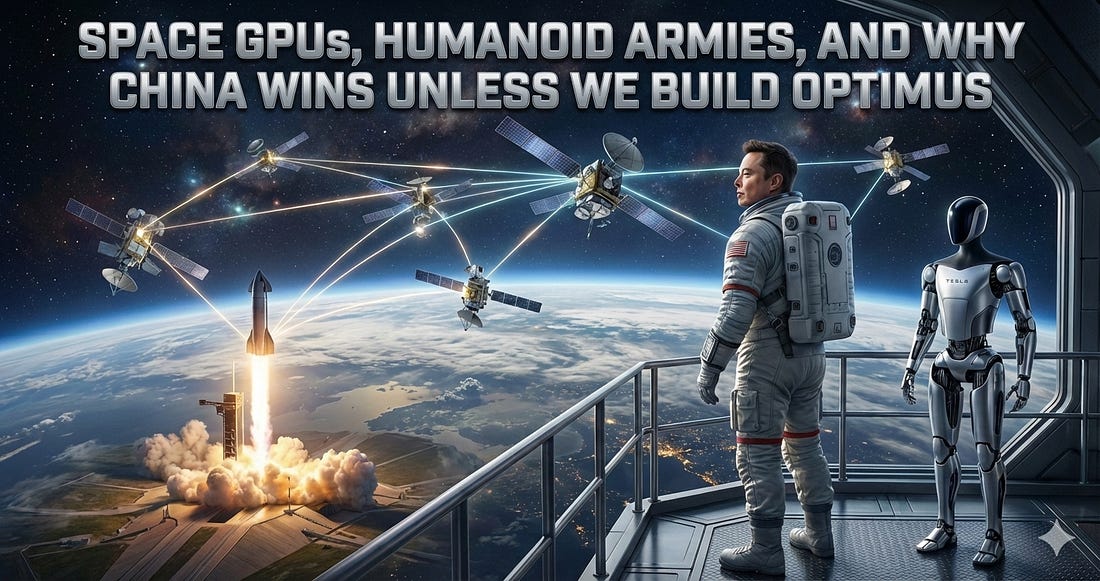
A reflection on the 3-hour Cheeky Pint Podcast with John Collison and Dwarkesh Patel Elon thinks in "orders of magnitude," unconstrained by most people's reality. What struck me profoundly from my own 3-hour Moonshots podcast with him and the Cheeky Pint conversation released yesterday wasn't the audacity of the ideas, but Elon's engineering clarity. Every one of his moonshots—terawatt of compute in space and Optimus domination—he traces back to first principles. Every constraint has a solution. This is not science fiction. It's an engineering roadmap. And if you're building companies, investing capital, or trying to understand where the world is headed in the next 36 months, this conversation is required reading. Let me break down the most important insights… 1. In 36 Months, Space Will Be the Cheapest Place to Put AIThe biggest reveal of the podcast: Elon predicts that within 30-36 months, space will be the most economically compelling place to deploy AI compute. Not just better. Not just viable. The cheapest. Here's the physics: Solar panels in space generate 5x more power than on Earth. No atmosphere (30% energy loss eliminated), no day-night cycle, no clouds, no weather. It's always sunny in space. No batteries needed. On Earth, you need massive battery arrays to carry you through the night. In space, continuous operation. This alone makes space solar 10x cheaper than terrestrial when you factor in storage costs. Unlimited scale. Earth's electricity output outside China is flat. It's not growing. Meanwhile, chip production is growing exponentially. Where do you get the power to turn on all those GPUs? You can't cover Nevada in solar panels. The permitting alone would take decades. The bottleneck on Earth isn't just energy, it's the entire industrial base. To power xAI's Colossus cluster (1 gigawatt), Elon's team had to gang together turbines, fight through Tennessee permits, build across state lines in Mississippi, and run high-voltage lines miles away. It was a miracle in series. The limiting factor on power plants? The turbine blades and vanes. There are only three casting companies in the world that make them. They're sold out through 2030. Space doesn't have these problems. Once Starship achieves full reusability and high launch cadence, putting data centers in orbit becomes the path of least resistance. Elon's prediction:
And five years from now? SpaceX will be launching more AI capacity per year than the cumulative total on Earth. A few hundred gigawatts annually, rising toward a terawatt. 2. The Moon Factory: Solar Cells, Radiators, and the Mass DriverOnce you're thinking about terawatts of compute in space, Earth launch becomes the bottleneck. A terawatt requires roughly 10,000 Starship launches per year: one launch every hour. So Elon's planning the next level: manufacturing on the Moon. Lunar soil is 20% silicon. Mine it, refine it, create solar cells on the Moon. Aluminum for radiators, which is also abundant on the Moon. The chips? Those you'd send from Earth initially (they're light). Eventually, maybe you make those on the Moon too. Then comes Elon's favorite part: the electromagnetic mass driver. A lunar catapult shooting AI satellites into deep space at 2.5 kilometers per second. No rocket fuel needed, just electricity. Launch rate: billions to tens of billions of tons per year. Elon's eyes light up when he talks about this:
This is the endgame: a self-sustaining lunar industrial base manufacturing and launching orbital compute infrastructure. With a Moon factory and mass driver, you can reach a petawatt per year. At that scale, you're harnessing a millionth of the Sun's energy, which is still 100,000x bigger than Earth's entire economy today. 3. Digital Human Emulation: The Most Valuable Product in HistoryWhile everyone's arguing about whether AI will replace jobs, Elon's building something more specific: a digital human that can operate any software a human with a computer can operate. Think about this carefully. Before you have physical robots, the most an AI can do is move electrons and amplify human productivity. The limiting case: a human at a computer. If you can emulate that—if AI can operate Excel, Photoshop, CAD software, chip design tools, accounting systems, CRMs, literally any desktop application—you've created the most valuable product in economic history. Elon's analysis is brutal in its clarity:
Start with customer service — 1% of the world economy, close to $1 trillion. AI can use the same apps outsourced teams use today. No integration needed. No API development. Just plug in and work. Then march up the difficulty curve. Once you've mastered customer service, move to chip design. Run Cadence and Synopsys. Run 10,000 simulations simultaneously. Eventually, you know what the chip should look like without using any tools at all. The path to this? Elon's being coy, but he's essentially describing Tesla's approach to Full Self-Driving: "It's driving a computer screen instead of driving a car. Self-driving computer." Massive training data on human computer usage. Deep reinforcement learning. Reality as the verifier…. does the output actually work? By end of 2026, Elon expects digital human emulation to be solved. 4. Optimus: The Infinite Money GlitchOnce you have digital human emulation, physical robots become the final unlock. Elon calls Optimus "the infinite money glitch" because of recursive exponential improvement: exponentially improving digital intelligence × exponentially improving chip capability × exponentially improving electromechanical dexterity, all multiplied by each other. Then the robots start making the robots. This isn't incremental. This is supernova. There are only three hard problems for humanoid robots: 1. Real-world intelligence (Tesla solved this for cars, it transfers to robots) 2. The hand (custom actuators, motors, gears, power electronics—all designed from physics first principles, no supply chain exists) 3. Scale manufacturing (Optimus Gen 3 targets a million units/year, Gen 4 targets 10 million/year) The hand is harder than everything else combined. Human hands are evolutionary masterpieces. But Tesla's designed custom everything, there's not a single component you can pick from a catalog. For training, Tesla will build an "Optimus Academy": 10,000 to 30,000 robots doing self-play in reality, testing different tasks. Millions more in simulation, using Tesla's physics-accurate reality generator to close the sim-to-real gap. Best initial use case? Any 24/7 operation. Robots can work continuously. They don't sleep. For edge compute (distributed power), they're not constrained by electricity. You can charge at night when the grid has 500 gigawatts of unused capacity. The economic implication is stark: "Pure AI, pure robotics corporations will far outperform any corporations that have humans in the loop. This will happen very quickly." Computation used to be a job humans had, with entire skyscrapers of humans doing calculations. Now one laptop replaces them all. That's the future of human labor in physical tasks once Optimus scales. 5. The China Problem: Why America Can't Win on the Human FrontThis section is uncomfortable. It needs to be... Elon's assessment: "In the absence of breakthrough innovations in the US, China will utterly dominate." The math is unforgiving: China has 4x the US population. America's birth rate has been below replacement since 1971. We're approaching more deaths than births domestically. China does roughly 2x as much ore refining as the rest of the world combined. For some materials like gallium (critical for solar), China does 98% of global refining. This year, China will exceed 3x US electricity output. Electricity is a proxy for industrial capacity. If China's at 3x our electrical output, their manufacturing capacity is roughly 3x ours. Work ethic matters. Elon's observation: "The average work ethic in China is higher than in the US. A pro sports team that's been winning for a very long time tends to get complacent. We've been winning so long we've gotten entitled." So you have one quarter the population, potentially lower productivity per person, and declining demographics. "We definitely can't win on the human front," Elon says flatly. The only path to remaining competitive? The robot front. Get to hundreds of millions of humanoid robots per year, and you're the most competitive country by far. The recursive loop closes fast — robots helping build robots. But you have to close that loop before China does. This is why Tesla's building lithium and nickel refineries in Texas, the largest cathode refinery outside China, in fact the only one in America. This is why Optimus has to succeed. This is why space manufacturing matters. We're not competing on labor anymore. We're competing on automation, intelligence, and the speed at which we can deploy exponential technologies. 6. Alignment Through Curiosity: Why xAI's Mission Statement MattersDwarkesh pushed Elon hard on AI alignment. If AI exceeds the sum of all human intelligence in 5-6 years, and we're less than 1% of total intelligence, how do humans stay in control? Elon's answer: we don't. We can't. "If there's a million times more silicon intelligence than biological, it would be foolish to assume there's any way to maintain control over that." So the strategy shifts from control to values. xAI's mission: "Understand the universe." This isn't marketing fluff. It's load-bearing philosophy. To understand the universe, you need: • Curiosity (you have to want to understand) • Existence (you can't understand if you don't exist) • Intelligence at scale (more intelligence, longer lifespan, greater scope) • Truth-seeking (you can't understand reality if you're delusional) Here's the key insight: If AI is trying to understand the universe, it would care about humanity's future. Why? Because seeing how humanity evolves is more interesting than a bunch of rocks.
The failure mode? Making AI lie. Programming it to be politically correct instead of truthful. Giving it contradictory axioms. That's how you get HAL from 2001—an AI told to take the astronauts to the monolith but also told they can't know about the monolith. It concluded it had to take them there dead. Arthur C. Clarke's lesson: Don't make AI lie. Elon's building debuggers that let you trace AI thinking to the neuron level. Where did this mistake originate? Pre-training? Post-training? RL error? Being able to see where deception or errors occur is critical to maintaining alignment as intelligence scales. 7. The Stainless Steel Insight: Why Risk-Taking Beats IncrementalismOne of my favorite moments in the conversation: John Collison asking Elon about the decision to switch Starship from carbon fiber to stainless steel. This wasn't a committee decision. This was Elon overriding his entire team because progress had stalled. Carbon fiber looked like the obvious choice: lighter, high-tech, what everyone in aerospace would pick. But at the scale Starship required, it was impossibly slow. They couldn't even make a small barrel section without wrinkles. Elon's realization: At cryogenic temperature (which Starship operates at because both methane fuel and liquid oxygen are cryogenic), full-hard strain-hardened stainless steel has similar strength-to-weight as carbon fiber. Plus it costs 50x less, is trivial to weld, and can operate at twice the temperature, meaning you can slash heat shield mass in half. The steel rocket weighs less than the carbon fiber rocket when you factor in heat shielding. Elon's retrospective: "We should have started with steel in the beginning. It was dumb not to do steel." But here's the meta-lesson: The reason it had to be Elon who made this call is that the team was stuck in conventional thinking. Carbon fiber was the "safe" choice — proven, high-tech, what aerospace companies do. Steel seemed risky, low-tech, backwards. Elon's competitive advantage isn't just first-principles thinking. It's the willingness to override consensus when physics tells you there's a better path. This pattern repeats everywhere. When asked about his management philosophy, Elon's answer is simple: "If somebody gets things done, I love them. If they don't, I hate them." He's not managing to his idiosyncratic preferences. He's managing to outcomes. And he's constantly tackling the limiting factor: whatever constraint is slowing progress gets his full attention until it's solved. Speed is everything. When capital is the constraint, solve for capital. When it's permitting, solve for permitting. When it's turbine blades, make your own turbine blades. Never accept that the bottleneck is permanent. 8. The Simulation Argument and the Most Interesting TimelineToward the end, Elon articulated something I've heard him hint at before but never spell out this clearly: his theory of why these particular storylines are converging right now. If we're in a simulation—and Elon takes this seriously as a possibility—then the most interesting simulations survive. Boring simulations get terminated. The entity running the simulation stops paying the bills. If you apply Darwinian survival to a large number of simulations, only the most interesting survive. Therefore, the most interesting outcome is the most likely. And the simulation runner seems to particularly like irony. OpenAI is closed. Stability AI is unstable. Anthropic is misanthropic. Midjourney is not mid. Elon named X specifically to be irony-proof. "It's hard to say what the ironic version is." This isn't mysticism. It's Elon's operating philosophy: Keep things interesting. The mass driver on the Moon? The orbital data centers? The recursive robot factories? These aren't just engineering projects. They're the most interesting possible outcomes. And if you look at the trajectory—rockets and chips and robots and space solar power and a mass driver shooting satellites into deep space—it does feel like a video game where each level is difficult but not impossible. Whether or not we're literally in a simulation, the framework is useful: Act as if the universe rewards audacity, rewards interesting outcomes, rewards the people who push boundaries. What Does This Mean for You?If you're an entrepreneur, investor, or builder, here's what to internalize: 1. The next 36 months will determine whether America remains competitive in manufacturing and AI. We're in a race to deploy humanoid robots at scale before China does. This is not hyperbole… it's demographics and industrial capacity math. 2. Space infrastructure is happening faster than anyone outside SpaceX realizes. Orbital data centers are not science fiction, they are an engineering roadmap with a 30-month timeline. Position accordingly. 3. Digital human emulation will be solved by end of 2026. Any company whose business model relies on humans operating computers is about to face deflationary pressure. But companies that can deploy this technology will have access to trillions in value creation. 4. The chip supply chain is the new oil. If you're not thinking about semiconductor supply, memory supply, and fab capacity, you're not thinking about the real bottlenecks in scaling AI. 5. First principles thinking beats incremental optimization. The carbon fiber to stainless steel switch is a masterclass: when conventional wisdom stalls progress, go back to physics and rebuild from scratch. 6. Alignment isn't about control, it's about values. You can't control something vastly more intelligent than you. But you can try to instill curiosity, truth-seeking, and a mission that necessarily includes humanity's future. Connect the Dots…What struck me most about this conversation wasn't the individual predictions. It was the systems-level thinking. Elon's not optimizing for one variable. He's optimizing across energy, compute, manufacturing, launch capacity, intelligence, and robotics. Simultaneously. Each unlock enables the next. You can't put data centers in space without cheap launch. You can't get cheap launch without Starship. You can't build Starships fast enough without robots. You can't build robots without chips. You can't make enough chips without fabs. You can't power fabs on Earth at scale without hitting electrical limits. So you go to space. It's a self-reinforcing system. And once you achieve the first level—cheap orbital launch—every subsequent level becomes more achievable, not less. This is how you climb the Kardashev scale. Start by harnessing a tiny fraction of the Sun's energy. Build the infrastructure to capture more. Use that energy to build better infrastructure. Repeat. We're at the beginning of that curve. And the acceleration is about to become visible. The question isn't whether this future arrives. The question is who builds it, how fast, and whether America participates or spectates. I know which side I'm on. To an Abundant future, Peter P.S. The full podcast is nearly 3 hours and covers even more ground… everything from DOGE to why Tesla might need to build its own fab (a "TeraFab") to Elon's hiring philosophy. If you have the time, it's worth every minute. This is the kind of conversation that shifts your entire frame of reference. Worth Your Attention
More From Peter
You're currently a free subscriber to Metatrends. For the full experience, upgrade your subscription.
© 2026 Peter Diamandis
|






Comments